Sunday, June 8, 2014

What's on My Bedstand

Yes, Wendi and I are using a baggage cart to transport our books from the lobby of her building to her apartment.  And that's only one day's haul!  On Thursday, two boxes of books arrived at my front door.  When added to the 63 books that I schlepped home in my suitcases and carry-on, my total take from Book Expo was 147 books.   Many of the books are being distributed to friends and family.  There's Smoke Gets in My Eyes and Other Lessons from the Crematory by Caitlin Doughty for Bruce (don't ask) and Birds of Pandemonium by Michele Raffin for Dorrit; The Target by David Baldacci for Wanda; Secret Place by Tana French and One Plus One by JoJo Moyes for my sister; a YA version of Unbroken by Laura Hillenbrand and Guys Read: True Stories by Jon Scieska for my nephew.  The list goes on and on. So, what am I excited about reading this summer?  

The Magician's Lie by Greer MacAllister (pub date January 2015).  When you aren't rushing around the Javits Center grabbing galleys, you spend a fair amount of time on line waiting for authors to sign your treasures.  Usually, you don't get the book until you are about to step up to the podium where the author is signing.  Sometimes, though, they are handed out in advance.  And so I started reading The Magician's Lie as I was waiting for my turn to get MacAllister's signature.  I was immediately hooked by the book, which is being billed as "the next Water for Elephants".  It is a turn of the (20th) century story about a female illusionist who may have killed her husband.  I am 60 pages into it and am enthralled.

The Remedy for Love by Bill Roorbach (pub date October 2014).  My copy of Roorbach's Life Among Giants from the 2012 Book Expo is still unread despite my having made a modest attempt to start it.  So you wouldn't think that his latest would hold much attraction for me.  And yet, it does. First off, I liked Roorbach when I met him.  Algonquin is his publisher, and their authors have time to chat with the readers for whom they are signing (unlike Random House and MacMillan).  Roorbach had a multitude of colorful bands on his arms, which I learned had been made for him by his daughter and that he was under strict orders not to take them off.  The fact that he's a nice guy doesn't mean that he's a good writer, but the story of an odd couple who are thrown together to wait out the "Storm of the Century" grabs me for some reason.

The Arsonist by Sue Miller (available now).  There seemed to be more finished books being given away this year than usual, some of which were being signed.  Sue Miller was on hand, and there was a surprisingly short line for her latest book.  Having enjoyed her writing in The Senator's Wife, I'm looking forward to reading this one, which is a story of a family and a community tested when an arsonist begins setting fires to the homes of the summer people in a small New England town.

As always, I came away with lots of thrillers, both by authors who are old favorites (Jeffrey Deaver, Chelsea Cain) and by some who might be added to the list.  Although I hate the cover for Lacy Eye by Jessica Treadway, it's on my list.  (The book will be out in spring 2015.) The plot line sounds somewhat reminiscent of Defending Jacob by William Landry (i.e., a crime occurs and a mother questions whether her daughter was involved or not).  Nathan Filer's The Shock of the Fall (out now) also looks intriguing.  It won the Costa Book of the Year Award (under the title Where the Moon Isn't).  (This literary prize awards authors based in the UK and Ireland; previous winners include Hilary Mantel, Colm Toibin, and Kate Atkinson.)  His background as a mental health nurse who's worked in a psych ward lends credibility to his book that is, in part, about a 19-year old who suffers from schizophrenia.

Update on other books I've mentioned:  I finished Editor Buzz Book My Sunshine Away by M.O. Walsh.  I loved the way that Walsh captured the voice of his 14-year old narrator as he tries to make sense of his feelings for Lindy Simpson, the girl he's been in love with since the day the Space Shuttle Challenger crashed.  (This story was incredibly touching.)  When Lindy is raped, the boys/men in their neighborhood become suspects, including our narrator.   In general, I enjoyed Walsh's writing and the way he brought the story together.  What I didn't like was his incorporation of serial killer Jeffrey Dahmer into the story -- sort of a cautionary tale, sort of an analogy.  It didn't work for me and made me lose my focus on the core story.  Nonetheless, a very strong debut novel.  Look for it in January 2015.

33 Artists in 3 Acts by Sarah Thornton.  This is a fabulous book for anyone interested in contemporary art.  I've only read four scenes from the first "act" (Politics) so far about Jeffrey Koons and Ai Weiwei, but they are terrific.  (Remember porn star La Cicciolina who was Koons' wife for a year and then became a representative in the Italian government?)  I like the fact that the chapters are bite-sized so it's easy to read on the fly.  And I've never heard of most of the artists, so I will learn something in the process.  I feel tempted to pick up Thornton's Seven Days in the Art World as well, but the idea of buying any books right now is more than ridiculous.

Time to get reading!


Thursday, June 5, 2014

Ai Weiwei: According to What? at the Brooklyn Museum of Art

No trip to New York is complete without a visit to at least one museum.  And so my friend Andrea and I spent some time last Sunday at the Brooklyn Museum of Art to see a terrific exhibit about art during the Civil Rights Movement.  (More on this show later.) Building on this theme, the Museum's other exhibits also relate to social activism.   One of the shows is "Ai Weiwei:  According to What?"  We weren't familiar with Ai Weiwei's work, but decided to check it out.

Ai Weiwei is a contemporary Chinese artist who works in a variety of mediums -- photography, sculpture, architecture--while focusing on issues of freedom of expression and civil rights. He uses social media extensively in his efforts to raise awareness about societal issues and promote activism.  (His blog was shut down by the government, so he now uses Twitter as a primary means of communication.)  As a result of his political activism, Ai was imprisoned in 2011 for 81 days.  His passport was revoked, so he can no longer leave the country.  His artwork, however, still finds an audience in the world outside of China.

The exhibit contains a number of pictures and installation exhibits whose meaning isn't apparent unless you read the descriptions. Take, for instance, this photograph.  In 2009, Ai Weiwei was taken into police custody to prevent him from testifying at the trial of Tan Zuoren, a fellow activist.  (Among other "crimes," Zuoren was investigating substandard construction that caused schools to collapse during the Sichuan earthquake. More than 70,000 people died as a result of the earthquake, including 5300 students who were trapped when schools crumbled around them.) Ai took this picture of himself in custody and posted it on Twitter.  During the confrontation, the police struck him on the head, causing a brain hemorrhage. A few days later, he had to have emergency brain surgery.  The exhibit also contains pictures of his brain MRI (called "Brain Inflation").

In one room of the exhibit we found a pile of boxes and suitcases. A scooter and a bike were situated off to one side. The wallpaper had pictures of items of clothing, CDs, and kitchen gadgets. The installation is called "Ye Haiayn's Belongings, 2013."  Ye Haiyan is a Chinese AIDS awareness activist.  As a result of her politics, she and her family have been evicted on numerous occasions.  In one instance, the secret police forced them to pack their belongings and then drove them out of town, dumping them and their possessions on the side of the road with a warning not to return.  Ai became involved with the family, providing shelter for them in Beijing, and the images in this exhibit are some of their 2872 possessions that Weiwei catalogued.

Then there was the room relating to Han Dynasty Urns.  A trio of pictures shows Ai purposefully dropping a 2000 year old Han Dynasty Urn.  His intent was to visually break with Chinese cultural traditions and legacies.  In the foreground are a number of Han Dynasty Urns that have been dipped in industrial paint. According to the explanation, by doing this, Ai "asks viewers to consider questions of authenticity and the value and meaning of an original artwork."  I found this room the most shocking of the exhibit.

The room containing the "Moon Chest" was a respite from the intensity of the rest of the exhibit.  This installation was part of a series of 81 chests that Ai carved from the wood of Chinese quince trees.  Each chest has four circular openings, and when you look through the openings, you see different phases of the moon.  It was a beautiful installation, and viewers were having a lot of fun taking pictures of each other peering through the opening in the furthermost chest.

In an unexpected link to the Book Expo, one of the galleys I picked up is Sarah Thornton's 33 Artists in 3 Acts.   Thornton was the chief writer in contemporary art for The Economist and takes an interesting look at the work of 33 contemporary artists in her book, with Act I being "Politics."  Ai Weiwei is front and center in this section.

While doing her research for the book, Thornton attended a conference on "Designing China" at which Ai Weiwei spoke.  It happened to take place in the week between his confrontation with police described above and his emergency brain surgery.  A giant welt was visible on the side of his head.  The moderator introduced Ai Weiwei by saying, "Weiwei was a consultant on the Bird's Nest Stadium for the Beijing Olympics and has built an artistic compound in Caochangdi, an area near Beijing where he welcomes his friends and sometimes the police."

I am glad that Andrea and I didn't skip "Ai Weiwei: According to What?" as the work of an unfamiliar artist.  I left the exhibit feeling fortunate to live in a place where social activism is protected as free speech.  I also left with a newfound respect for the ways in which artists like Ai Weiwei can raise awareness about social issues through their art.

The exhibit runs through August 10th.  If you're in the New York area between now and then, I encourage you to take the time to check it out.


Tuesday, June 3, 2014

Listening in on Carl Hiaasen and John Grisham

Book Expo America embraced the "regular" reader in a big way this year with its introduction of "BookCon."  Historically, Book Expo has been an event for book industry insiders -- primarily booksellers and librarians who can get the word out about hot new books.  (In case you're wondering, I've slid in under a separate category for people involved in literacy work.)

Last year, Book Expo permitted "Power Readers" to attend the last day of the event.  It was a nod to the changes in the industry--consolidation, e-reading--and the corresponding diminution in BEA attendance.  From my vantage point, the Power Reader day didn't seem particularly organized -- just a few deer in the headlight people off the street wandering around the floor.  

That changed this year with the introduction of BookCon.  Book Expo brought in the promoters of Comic Con to organize a bigger and better take on the power reader concept.  The New York Times reported that over 8,000 people had purchased tickets to attend Saturday's session, which was chock full of special events in addition to the galley give-aways and author signings that have enticed me to attend over the years.  

Carl Hiaasen and John Grisham (cell phone cameras
have their limits!)  
I found myself in one of the BookCon sessions on Saturday morning--a conversation between authors Carl Hiaasen and John Grisham.  It was a pure delight.

Hiaasen and Grisham were hilarious as they talked about some of the reference materials they use. It turns out that the names of their characters don't just magically come to them. Grisham keeps a book of baby names on hand. On the other end of the spectrum, he collects obituaries.  "Dead people can't sue," Grisham noted. Hiaasen's response?  "I've come across families in Florida who couldn't trouble themselves to think up a new name so they just use the same one for multiple kids."  (Big laughs all around after this exchange.)

Phone books from rural counties in Florida have yielded the names of some of Hiaasen's characters.  And if you've ever wondered if he has trouble keeping up with his characters' antics, the answer is "yes."  Hiaasen uses a giant Post-It pad with arrows that show who did what to whom lest he lose track by the time he gets to Chapter 7.

Both Grisham and Hiaasen have allowed non-profits to auction off the inclusion of a person's name in an upcoming book -- and both have discarded the practice due to the advice of counsel.  People somehow don't like it when they end up being an unsavory character in a book or--worse yet--a character who appears only in passing.  Hiaasen recently had a surprising (to him) conversation in which a woman who won such an auction asked him when they were going to talk about the book he was writing "about" her.  What???

Newspaper clippings are a constant source of inspiration for their stories.  Hiaasen, who wrote for the Miami Herald before becoming a full-time novelist, talked about the abundance of wacky things that go on in Florida that just beg to be written about.  Take, for instance, former Florida Supreme Court Justice David McCain who turned to marijuana smuggling after he left the bench.  "Let me write this down," Grisham said.  Hiaasen went on to say that McCain died as a fugitive from justice living in a trailer park in Jacksonville.  "A trailer?" Grisham asked.  "Well," Hiaasen said, "it was a double wide."

It was an hour full of laughs with two authors who are at the top of their game.  I truly enjoyed their banter and their easy way of poking fun at themselves and each other.  If this is the type of event that BookCon will bring to the Book Expo, I am all for it.


Monday, June 2, 2014

Book Expo 2014 -- Editor Buzz Books

Each year, Wendi and I attend the Editor Book Buzz panel as a way to kick off our Book Expo experience.  This year editors from seven different publishing houses spoke passionately about a book they believe the world should read. This year's assortment was heavily weighted towards fiction, and many sounded like books that would make it to my nightstand.  Here's the line-up (in order of my personal interest).

(Not the final jacket)
My Sunshine Away by M.O. Walsh (pub date January 15) -- Like many buzz books, My Sunshine Away is a debut novel.  Editor Amy Einhorn talked a blue streak about this book, which she says is about "family, memory, forgiveness."  She read the first and last lines of the first chapter:  "There were four suspects in the rape of Lindy Simpson...I should tell you now that I was one of the suspects.  Hear me out.   Let me explain."  The narrator is a 14-year old boy who is swept up in the events of one summer in Baton Rouge, Louisiana.  In the words of Kathryn Stockett who wrote The Help (another of Einhorn's books), "My Sunshine Away is the story of how the events of our youth profoundly affect us as adults.  The last page is as satisfying as the first."  This book came home on the plane with me, and I am already halfway through.  Walsh's writing is beautiful, and the actions and emotions of his young narrator ring true.  

Neverhome by Laird Hunt (pub date September 9) -- Neverhome, Hunt's sixth novel, is set during the Civil War.  The opening line:  "I was strong and he was not, so it was me went to war to defend the Republic."  Yes, it's a story of a woman who goes to fight as a Union soldier, leaving her husband behind to tend the farm.  It's an intriguing idea, and one I'd never considered.  Editor Josh Kendall acknowledged an inevitable reference to Charles Frazier's Cold Mountain. (I neither read the book nor saw the movie.) Yentl was what came to my mind.  The backstory is interesting as well:  Laird got the idea for the book when he came upon some letters in his family's attic that had been written during the Civil War.   Definitely on my "to read" list despite the fact that historical fiction generally isn't my thing.

We Are Not Ourselves by Matthew Thomas (pub date September 2) -- It took Thomas ten years to write this debut novel about three generations of an Irish-American family in search of the American dream.  Matriarch Eileen Leary is "every woman" as she tries to make a better life for her family.  Editor Marysue Rucci says that the "arc of the story makes the book resplendent and wise."  Rucci also made a throwaway comment about a study indicating a link between reading literary fiction and being more empathetic, which I assume was an indication of how much you come to care about these characters.  (Click here for info about the study.)   Could be interesting if I'm in the mood for a saga.

Station Eleven by Emily St. John Mandel (pub date September 9) -- Editor Jennifer Jackson says that the publishing process was turned on its head when it came to this book.  A small press published three earlier books by St. John Mandel, and her readership created a groundswell of support for this author that led Knopf to take on this book.  In its opening, a famous actor dies during a production of King Lear.  From there the story moves back and forth in time, with the near future being different from today's world in a way that is "plausible and terrifying."  The book links the stories of the actor, the man who tried to save him, the actor's first wife, his oldest friends, and a young actress with something called the Traveling Symphony.   I am confused already, but might give it a try.

The Miniaturist: A Novel by Jessie Burton (pub date August 26) --When 18 year old Nella Oortman arrives in Amsterdam to marry merchant Johannes Brandt, his wedding present to her is an 8 foot tall dollhouse.  (Editor Lee Boudreaux noted that the Rijksmuseum's collection contains a dollhouse that was owned by Petronella Oortman that inspired this aspect of the story.)  Nella soon realizes that she is living in a house full of secrets with a husband who isn't particularly interested in her.  She turns to the dollhouse as a diversion, ordering perfectly made to scale pieces. Once they are delivered, items she didn't order keep coming.  What is their meaning?  Do they presage events to come?  Burton's attention to detail caused Boudreaux to draw a parallel in her writing to that of Elizabeth Gilbert in the botanical story Signature of All Things.  Sounds too fussy for me.

The Short and Tragic Life of Robert Peace:  A Brilliant Young Man Who Left Newark for the Ivy League and Did Not Survive by Jeff Hobbs (pub date September 23) -- The title of this book more or less tells the story.  Despite the odds (unwed mother, murderer father, impoverished childhood), Peace left Newark to attend Yale where he studied molecular biophysics and biochemistry.  Upon his return to Newark to teach at the Catholic high school he had attended, Peace ended up supplementing his teacher's salary by dealing marijuana.  (If I understood editor Colin Harrison correctly, Peace used his scientific knowledge to make the marijuana he sold more powerful.  Visions of "Breaking Bad" came to mind.) The book, written by Peace's roommate from Yale, talks about the duality of Peace's life as he tried to balance life in the classroom and life on the street.  Harrison says the book is not a pleasurable read, but that he was "staggered" by the time he got to the last page.  I guess I need to spend more time reading literary fiction, because I don't feel enough empathy for Robert Peace to tackle this book.  

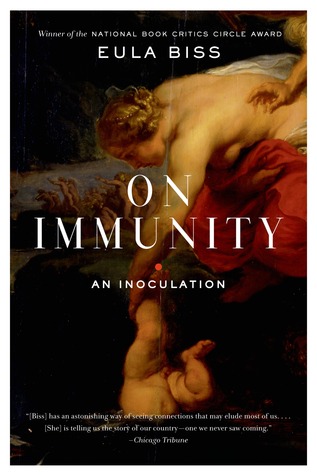
On Immunity:  An Innoculation by Eula Bliss (Graywolf Press) --I don't read much non-fiction, and a book about the history of vaccination and its related current-day social issues does not grab me. If the concept sounds interesting to you, though, check it out.  Editor Jeffrey Shotts (how perfect is that?) compares Bliss to Joan Didion.  Shotts also edited The Empathy Exams, a book that has caught my interest.  On Immunity hands down wins the prize for best cover art of the bunch:  a detail from a Rubens painting showing the mythological figure Thetis dipping the infant Achilles into the River Styx.  (Interestingly, the Ringling Museum's collection includes a "modello" of Rubens' "The History of Achilles" which includes this image .  While I might not want to read An Innoculation, I will stop by to admire the painting on my next visit to Sarasota.)

As the final editor wrapped, the crowd pressed forward to get their galleys of the books that had just been spoken about.  It was not pretty, with eagerness winning out over politeness in many instances.  But it was a great warm-up for the main event when the doors opened at 9 a.m. on Thursday.  I was ready.

Wednesday, May 28, 2014

Blanchard House Museum Presents Espionage Exhibit

I'm an espionage fan from way back.  And so I found myself recently at Punta Gorda's own Blanchard House Museum to see its exhibit on "African-American Espionage During the Civil War."  It was an interesting exhibit that showcased the bravery--and creativity-- of African-Americans who fought against slavery during the Civil War by serving as spies.  

I enjoyed the irony of the fact that racism resulted in African-Americans being well-situated to engage in espionage.  Slaves were part of the background of Southern life.  Most slave owners assumed that African-Americans lacked the intelligence to understand information they overheard about troop movements and the like.  And of course most, but not all, slaves were illiterate, so important documents were often left in plain view for slaves who did have reading skills to see.  (This tidbit reminded me of the scene in "Invention of Wings" by Sue Monk Kidd when Sarah is told that she has engaged in an act of treason by teaching Handful how to read.)    
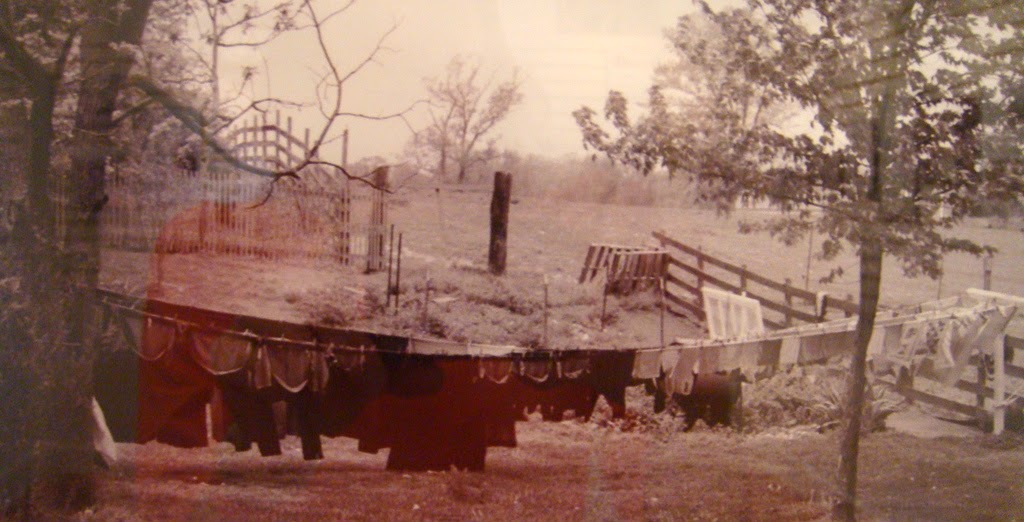
One device used to pass information was the “clothesline telegraph,” Dabney was a cook with Union General Joseph Hooker's camp outside Fredericksburg, Virginia.  Dabney's wife (whose name is not known) worked as a laundress in Fredericksburg for a number of Confederate soldiers, a job that allowed her access to considerable information about troop movements.  The couple established a system pursuant to which each Confederate general was assigned a shirt color and and each placement of the shirt on the clothesline represented a different location.  With each change to the clothesline, Dabney and, in turn, General Hooker received considerable intelligence about Confederate plans.   

Not all whites were of the view that African-Americans should remain slaves.  Elizabeth Van Lew was from a prominent Richmond family.  Following her father's death, all of the slaves in the Van Lew household were freed.  Among them was Mary Bowser.  Recognizing Bowser's intelligence, Van Lew arranged for her to be educated at the Quaker School for Negroes in Philadelphia.  Bowser returned to Richmond after graduation, and Van Lew enlisted her as a spy.  Bowser worked as a housemaid for Jefferson Davis at the “Southern White House” where documentation about the war was readily available.  (For those of us who have forgotten our history, Davis was the President of the Confederate States of America during the Civil War.)  Little did President and Mrs. Davis know that Bowser was not only literate, but she had a photographic memory.   

One way that Bowser passed along information was through the use of  hollowed out eggs that were placed in a basket along with real eggs.  When the eggs were delivered, the recipient could make an omelet while deciphering the coded message.  


And who doesn’t love the old invisible ink trick?  It was a favorite of Van Lew as well.  A secret message would be written in sugar water in a seemingly innocuous piece of correspondence, only to be revealed when the recipient passed the letter over a flame.  Simple yet effective.  

Thanks to Dr. Martha Bireda, Executive Director of Blanchard House Museum, and Jill, Scot and Beth Shively for putting together this interesting exhibit.


Wednesday, May 21, 2014

You Should Have Known by Jean Hanff Korelitz

As I gear up for my annual outing to Book Expo, I've been perusing my bookshelves to see what books I lugged home from last year's event that remain unread.  "You Should Have Known" by Jean Hanff Korelitz was one of them.  There's been a profusion of reviews (universally favorable) about this thriller from papers and magazines as disparate as the New York Times and People and Vogue.  So what was I waiting for?

Perhaps it was the premise of the book that put me off.  Grace, our protagonist, is a therapist on the Upper East Side who specializes in couples/relationship therapy.  She's written a book -- entitled "You Should Have Known" -- whose thesis is that if people just paid more attention early on in a (failed) relationship, they would be able to identify all those character traits that ultimately become so unbearable in your partner.

Graces chastises her clients (at least to herself) for not listening to that inner voice.  In an interview about her upcoming book, she says, "If we were to bring to [relationships] a fraction of the care we brought to, for example, our consumer decisions, problems would arise far less than they do?...We'll try on twenty pairs of shoes before we make a purchase.  We'll read reviews by total strangers before we choose someone to install our carpeting.  But we turn off our bullshit detector and toss out our own natural impressions because we find someone attractive, or because he seems interested in us.  He could be holding up a placard that says I will take your money, make passes at your girlfriends and leave you consistently bereft of love and support and we'll find a way to forget that we ever knew that.  We'll find a way to un-know that."  Hmm.

Korelitz' writing is very readable, and she interjects a fair amount of humor and satire into her work.  Take, for instance, the committee meeting for a benefit for her son's school that Grace attends.  On the list of auction items:  a "toe shortening" by a doctor who's "famous for making the second toe shorter than the big toe." And later, at said benefit, Grace meets a woman "whose lips are so swollen that she wonders if the mild looking and slightly distracted looking man with her had recently hit her in the face."  (These scenes made me flash back to "Where'd You Go, Bernadette?" and its hilarious private school event.)

Of course, Grace gets her comeuppance -- in spades.  If only she had applied her advice to her own relationship.  The twists and turns are fairly remarkable, and once I cracked the book open, it was hard to put down.  "You Should Have Known" is a book worth bringing along on your summer vacation.


Saturday, May 17, 2014

Best of......

Writing for Florida Weekly's "best of" edition (which compiles Charlotte County's "obscure, scandalous, the whimsical and wondrous") is always lots of fun.  Throughout the year, I keep my eyes open for curiosities that warrant a "best of" blurb.  Here are a few of my favorite submissions this year (along with their back stories).

A few months back, my friend Dorrit asked, "What's the deal with that knight sitting in the middle of a field just over the bridge?"  I have to admit that I'd never noticed him!  Now we both know.

Best Knight in Shining Armor
>>Statue by Wilson Real Estate

Auctioneer about town Phil Wilson long ago promised his wife Linda a knight in shining armor. On a trip to Mount Dora, Wilson came upon this physical incarnation of his promise and couldn’t resist. Who says chivalry is dead?  

I have always been an avid reader of mysteries and thrillers. So you can imagine my surprise (and excitement) when I learned that the Board of the Visual Arts Center has a former Secret Service agent in its midst--Jared Yankwitt.  The Secret Service's loss is our gain.


Best Keeper of Secrets:  Jared Yankwitt

Netflix’ “House of Cards” might make being a secret service agent look glamorous (especially if you’re watching over the Underwoods), but former agent Jared Yankwitt confides that the job is actually pretty boring. He might just be being coy, though. After all, he did have a top secret security clearance.  


I am on the look-out for amusing signage throughout the year, and Calusa State Bank often has something to offer.  Earlier in the season the marquee read:  "When life gives you lemmings, make lemonade."  It got my attention, but also grossed me out.  I liked this one a lot more. 

Best (Boston) Accent:  Calusa State Bank

Most bank marquees remind passersby about community events or low mortgage rates. While Calusa State Bank’s marquees also serve this function, they sometimes provide a chuckle or a groan, depending upon your sense of humor.  Either way, they’re worth keeping an eye on. 
 
Everyone in Punta Gorda knows Bonnie Yonker and the Yoga Sanctuary.  Bonnie often includes pictures of her daughter Maya in the monthly newsletter.  Last year we named Maya "best budding yogi" for her incredibly cute "happy baby" asana.  I couldn't resist using her again this year.

Best Budding Yogi, Take 2:  Maya Yonker

For the second year running, Maya Yonker wins the prize for best budding yogi. Mom Bonnie owns the Yoga Sanctuary, and at the ripe age of 21 months Maya is now purposefully doing yoga poses. The question is: With her zen attitude, will Maya still subject her parents to the “terrible twos”? 

I still can't quite get my head around a sex shop in the middle of Port Charlotte.  I noticed the store last fall with its eye-catching sign, and it immediately went on my list.  Turns out that the store has been there years, although the signage was updated last fall.  When I spoke to the manager, he was quick to tell me that their customers are not just guys coming in to pick up something "for" their girlfriend.  His words were borne out the day I pulled over to snap this shot as a happy looking couple made their way to their car.

Best Toy Store:  Jack n Jill Adult Superstore

The Villages apparently don’t have anything on Charlotte County. Despite the County’s demographics, business is booming at this “adult entertainment store.” A new location will open in Venice later this year. Come one, come all.

I've already started putting my list together for next year.  Let me know if you see something just wacky enough to include! 


"Botero in New York" at Sotheby's

"Woman in the Bathroom" (2002) I distinctly remember the first time I saw a painting by Fernando Botero. I was going to a lecture ...